From Backorders to Downtime—Designing Resilience
Supply disruptions and system outages expose vulnerabilities in blood collection processes- ranging from fragmented device choices and inconsistent techniques to mismatched cart setups across units and improvised substitutions during backorders. The result is foreseeable—more redraws, more sharps waste, and more stress on staff and patients. A resilient, sustainable program flips the script by standardizing devices, codifying inventory logic, and rehearsing downtime, so care continues smoothly—even when operations don’t. This playbook defines a framework for establishing an emergency-ready, low-waste blood collection program leveraging on RELI® devices, validated inventory management protocols, and simple drills that can be standardized across units.
Map the Workflow
Before changing a single SKU, map the blood collection workflow from order entry to specimen receipt and result posting. Look for four recurring failure modes:
- Device variation: Mixed safety mechanisms and unfamiliar activation steps increase activation errors, needlestick risk, and time per draw.
- Technique drift: Inconsistent gauge selection, tourniquet time, anchoring, order of draw, and tube inversion drive hemolysis, underfills, and redraws.
- Supply friction: Carts missing core items, poorly labeled bins, or near-expiry substitutes slow clinicians and increase waste.
- Documentation gaps: When EHR/LIS goes down, the absence of a tested manual process invites mislabeling, reconciliation delays, and specimen rejections.
Create a quick failure-modes grid with columns for Device, Technique, Supply, and Documentation. Under each, list the top 2–3 risks and the countermeasures you’ll implement in the next 90 days.
Helpful explainer for staff refreshers: The Right Tools for Blood Collection.
Build the Core Formulary (Standard RELI® Kit)
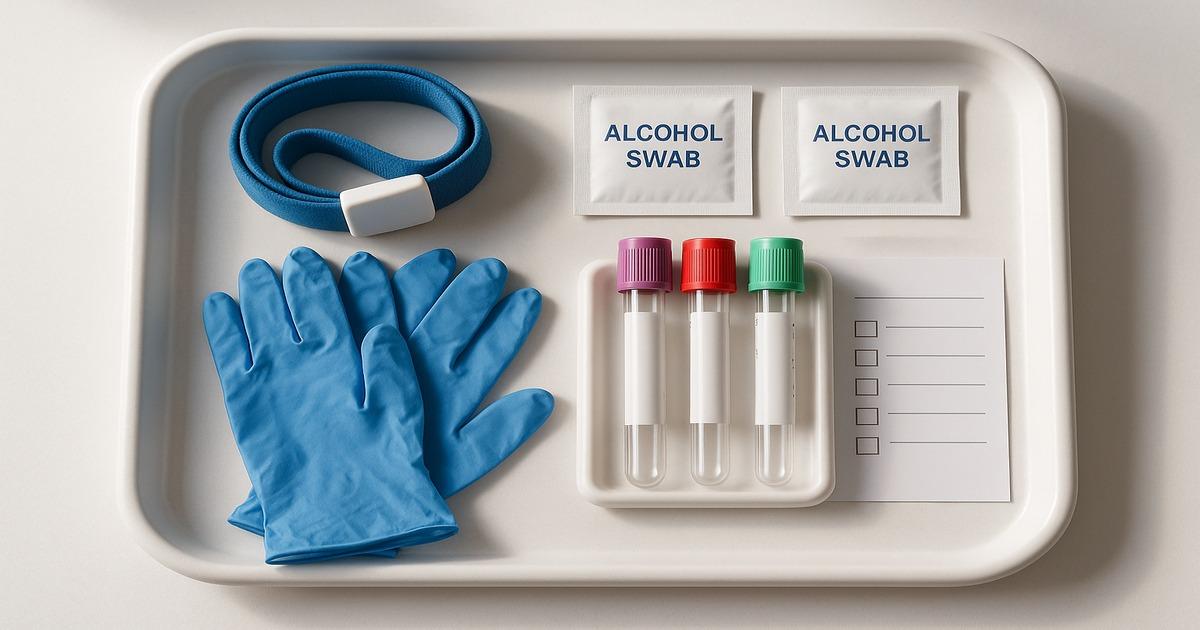
Resilience starts with fewer variables at the bedside. Create a standardized RELI® kit that is identical across units so training, muscle memory, and audits are simpler:
Why it matters: One safety mechanism and consistent activation steps reduce cognitive load, speed onboarding, and lower both needlestick risk and redraws. Standard kits also make carts legible at a glance: clinicians know exactly where items live, how they activate, and what to expect shift to shift.
Right-Size Inventory (Pars, First-Expire, First-Out, Dashboards)
Emergency-readiness depends on inventory engineered for reliability:
- Unit-Level Pars: Model pars by census, historical draw volume, and delivery cadence; add a 10–15% surge buffer for seasonal peaks.
- First-Expire, First-Out (FEFO) Rotation: Use FEFO; face earlier expiries forward and month-label bins for fast audits.
- Visual Triggers: Bin flags/Kanban cards that signal reorder at minimums—robust even during IT downtime.
- Dashboards: Track stockouts per unit, expired items, days-of-supply for critical SKUs, and cost per successful draw.
By right-sizing inventory, you maintain continuity without hoarding, cut waste tied to expiries, and sustain consistent device availability that preserves technique.
Continuity Planning (Pre-Approved Alternates)
Backorders are inevitable-continuity comes from pre-approved substitutes that protect technique:
- Select alternates within the same category and safety mechanism to maintain staff consistency.
- Define and document substitution rules (what to pull, where it lives, how it’s labeled) and label bins accordingly
- Communicate changes in shift huddles.
- Review with Supply Chain, Clinical Education, and Value Analysis quarterly to keep the plan current.
Sharps-safety refresher for rollouts: Safe Needle Disposal with MYCO’s Sharps Safety Products.
Deploy Mobile Go-Kits (Contents, Labeling, Restock)
When care moves, readiness must move with it. Build sealed, mobile “go-kits” for ED surge rooms, ICU, step-down, satellite clinics, ambulatory draws, and disaster triage:
- Mirror the core formulary: Include RELI® safety set by gauge (21G/22G/23G), safety holders, transfer device, tourniquet, gauze, alcohol swabs, labels, and specimen bags.
- Label by gauge/use case: e.g., “21G Standard,” “23G Fragile Veins,” with quick indications.
- Pocket card: Activation reminders, order of draw, gentle inversion counts, hemolysis tips.
- Restock cadence: Trigger restock after each use; weekly cycle counts keep kits from drifting.
Downtime in 10 Minutes (A Simple, Testable SOP)
System outages are inevitable. A 10-minute downtime SOP keeps collections safe and traceable:
- Paper requisitions & preprinted labels staged in downtime kits; two identifiers required.
- Manual verification at bedside with date/time and collector initials.
- Order of draw & gentle inversions reinforced on the pocket card.
- Specimen log sheet (collector, time, tests, temporary MRN/visit).
- Reconciliation procedure for system restoration (owner, handoff point, discrepancy workflow).
Drill monthly with a 10-minute tabletop per unit.
Sustainability Wins (Less Waste, Lower Risk, Lower Cost)
- Fewer redraws → fewer tubes/devices used and lower biohazard waste; faster throughput.
- Consistent ESIP activation → fewer needlesticks/near-misses.
- FEFO + pars → fewer expiries and smoother purchasing.
- Go-kits → supplies follow the work instead of piling up.
Track hemolysis rate, redraw rate, waste weight/100 draws, expired SKU count, stockouts/unit, needlestick/near-miss rate, and cost/successful draw. Report monthly to Nursing, Lab, and Supply Chain.
Case Snapshot: A 90-Day Rollout (Hypothetical)
- Days 0–30: Map workflow and risks; finalize the standardized RELI® kit; define unit-specific pars; set FEFO labeling; document pre-approved alternates; draft the downtime SOP; assemble pilot go-kits for ED/ICU.
- Days 31–60: 15-minute in-service; deploy to two pilot units; implement bin flags and KPI dashboard; run first downtime drill and capture lessons learned.
- Days 61–90: Scale to Med-Surg; tune pars by consumption; finalize alternates roster; add barcode/card-return restock; publish the first KPI report to leadership.
Typical early outcomes: 15–25% redraw reduction on pilot units; expiries halved on standardized SKUs; fewer activation errors/near-misses; faster time-to-first-draw in surges.
Explore Blood Collection Solutions for Your Practice
Ready to elevate your blood collection process? Browse the full RELI® Blood Collection lineup to view specs, compare products, or place an order.
Interested in testing before committing? Request a free sample or product demo and let our team help you find the perfect fit for your facility.
Frequently Asked Questions
- What’s the fastest way to start standardizing our blood collection kits?
Begin with one pilot unit (ED or ICU). Lock a single safety set (e.g., RELI® Push-Button), safety holder, and transfer device; label bins; run a 15-minute in-service; and audit after two weeks.
- How do par levels and FEFO reduce waste?
Pars prevent both stockouts and hoarding; FEFO rotation keeps earlier expiries forward so supplies get used on time. Most sites see expired SKUs drop once bins are labeled and pars are tuned monthly.
- What’s in a mobile “go-kit” for surges or off-unit draws?
Match the standard kit: safety set by gauge, safety tube holder, transfer device, tourniquet, gauze, labels/specimen bags, and a pocket card (order of draw, inversions, downtime steps).
- How do we manage backorders without retraining everyone?
Use pre-approved alternates with the same safety mechanism/activation style to preserve muscle memory. Store and label alternates clearly; announce switches in shift huddles.
- When should we choose Safety Slide™ sets?
Use them when clinical scenarios call for combined infusion/collection or where the sliding cartridge and one- or two-handed activation support workflow needs.
- How do downtime SOPs prevent redraws?
Pre-staged paper requisitions and labels, two-identifier bedside verification, pocket-card technique reminders, and a simple reconciliation flow keep specimens traceable and intact until systems return.


.png)

.jpg)
.jpg)